Breakthroughs in rare disease research often begin as bold, unconventional ideas—ideas that do not always fit neatly into narrowly defined requests for applications or traditional funding cycles. Since its founding, the Neurofibromatosis Therapeutic Acceleration Program (NTAP) has addressed this challenge through its Open Proposal Program, a flexible funding mechanism designed to capture innovation when it emerges and accelerate progress against the challenges of neurofibromatosis type 1 (NF1) associated peripheral nerve sheath tumors.
NTAP reflected on more than a decade of impact from this quietly powerful program—one that has helped shape the global research landscape for cutaneous, plexiform, and atypical neurofibromas.
A Funding Model Built for Agility
The Open Proposal Program is a core component of NTAP’s investment strategy. Complementing our often narrowly scoped funding opportunity announcements, it has historically allowed investigators to submit proposals on a rolling, year-round basis for research focused on NF1 peripheral nerve sheath tumors, including cutaneous neurofibromas (cNF), plexiform neurofibromas (pNF), and atypical neurofibromas (aNF), atypical neurofibromatous neoplasm with uncertain biologic potential (ANNUBP).
Moving forward, the program will transition to two funding cycles per year rather than accepting rolling submissions. This approach preserves access while providing greater structure and predictability for applicants.
Throughout this evolution, NTAP remains committed to its milestone-driven framework and rigorous peer review process. All projects are evaluated based on scientific merit, translational potential, and alignment with NTAP’s mission to accelerate the development of therapies for NF1 associated cNF, pNF and aNF/ANNUBP.
Thirteen Years of Measurable Impact
Since launching in 2012, the Open Proposal Program has received 79 applications and funded 31 projects—approximately 40% of proposals submitted. Of these, 26 projects are complete and five are active, reflecting a sustained pipeline of innovation over 13 years.
The portfolio is intentionally weighted toward translational science, with more than half of funded projects focused on building model systems, assays, and tools that directly enable preclinical therapeutic development. By disease focus, funding has predominantly supported plexiform neurofibroma research, while investment in cutaneous neurofibromas has grown rapidly as momentum in this historically understudied area has accelerated.
Extraordinary Return on Investment
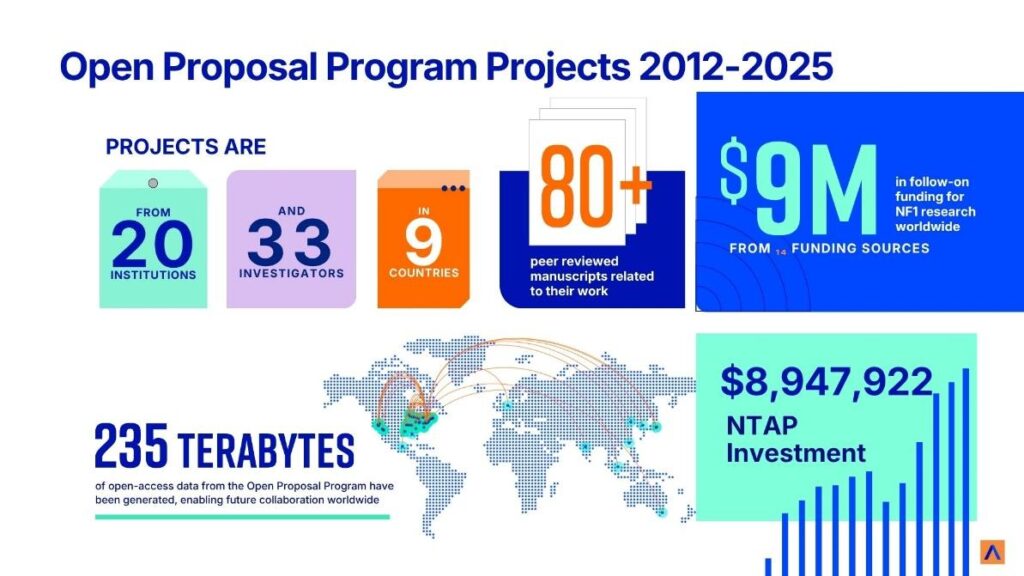
With a total NTAP investment of approximately $9 million, Open Proposal–funded projects have generated an outsized return:
- Over 80 peer-reviewed manuscripts
- More than $9 million in follow-on funding from 14 independent funding sources
- 235 terabytes of open access data, representing 43% of all openly shared data generated by NTAP funded investigators
- A global network of 33 investigators from 20 institutions across 9 countries
This impact extends far beyond individual awards. By requiring open data sharing and embedding projects within NTAP’s collaborative infrastructure, the Open Proposal Program transforms discrete studies into reusable resources that fuel future discovery worldwide.
From Early Ideas to Clinical Impact
Many of NTAP’s most field-shaping advances can be traced back to Open Proposal–funded projects. These include studies that established how cutaneous neurofibromas should be measured and visualized for clinical trials, research that defined clinical endpoints now used in modern therapeutic studies for pNF and cNF, and pilot projects that demonstrated how existing clinical trial data could be leveraged to create reusable tissue and data repositories.
Several Open Proposal projects have directly advanced clinical care, including work that led to the European Medical Agency’s approval of high-intensity focused ultrasound (HIFU) for the treatment of cutaneous neurofibromas and research that catalyzed clinical development plans for repurposed therapies now under active investigation.
In some cases, modest early investments produced long-term ripple effects. One Open Proposal project focused on targeting metabolic pathways in pNF, ultimately led to five follow-on grants and 14 publications, expanding its impact well beyond NF1 into broader oncology research.
Open Proposal Program Investigators Andrea Rasola, University of Padova, and Giorgio Colombo, University of Pavia“Early-stage funding mechanisms like the NTAP Open Proposal Program play a critical role in building the foundation for future scientific investment. The support we received enabled us to generate compelling preliminary data, strengthen collaborations, and demonstrate the feasibility of our approach. These achievements were instrumental in helping us secure follow-on funding and expand the scope and potential impact of the research. NTAP’s willingness to support innovative, exploratory science creates opportunities that extend far beyond the initial award itself.”
Turning Opportunity into Progress
The Open Proposal Program was designed to ensure that no promising idea is missed—and the results speak for themselves. By pairing agility with accountability, and creativity with collaboration, NTAP has transformed early-stage innovation into enduring impact.
As NTAP looks ahead, the Open Proposal Program remains a critical engine for discovery—opening doors to innovation, nurturing bold science, and accelerating the path toward effective therapies for people living with NF1 peripheral nerve sheath tumors.